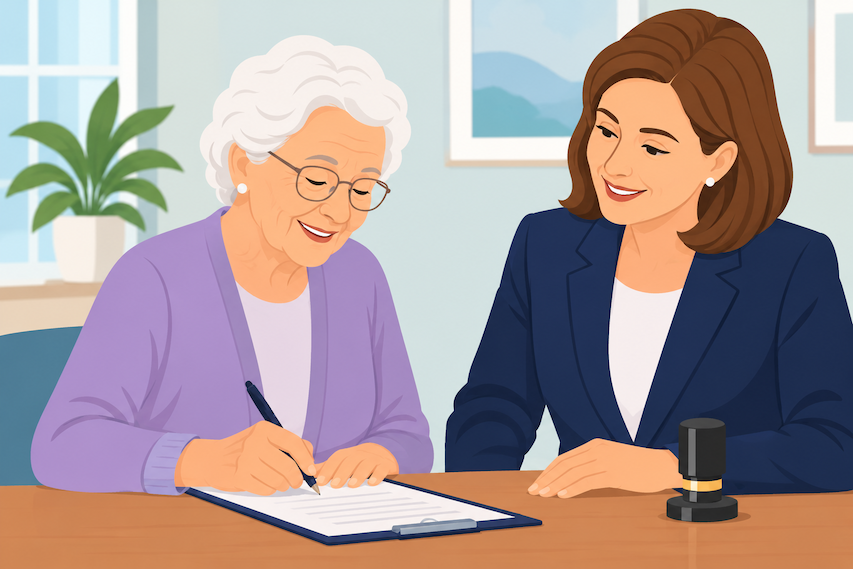
Yes. An elderly person can sign legal documents with a notary as long as the signer meets the applicable identification and notarization requirements and can understand the nature and effect of the document. Age, limited mobility, hearing difficulties, or physical disabilities do not automatically prevent someone from having a document notarized. What matters is the individual’s ability to participate in the signing process and satisfy the legal requirements.
For families helping an older parent or loved one complete important paperwork, understanding these requirements can prevent unnecessary delays and confusion. A professional notary can help facilitate the appointment while respecting the elderly person’s independence, communication needs, and right to make their own decisions.
In Florida, these considerations are particularly important when notarizing powers of attorney, estate planning documents, healthcare directives, affidavits, and other legal paperwork.
Can an Elderly Person Legally Sign a Document With a Notary?
Yes. Florida does not automatically disqualify someone from signing a notarized document because of age. An older adult can complete a notarization if the applicable requirements are satisfied and the notary can proceed without violating state law.
A person’s age should never be treated as proof that they cannot make their own decisions. Many seniors remain fully capable of understanding documents, communicating their intentions, and independently completing legal transactions.
However, the notary must pay attention to the circumstances surrounding the signing.
In Florida, the notary cannot notarize a signature if it appears that the person is mentally incapable of understanding the nature and effect of the document at the time of notarization. This requirement is outlined in Florida Statutes Section 117.107(5).
The distinction is important: being elderly is not the same as being unable to understand a legal document.
Does Being Elderly Automatically Mean Someone Cannot Sign?
No. A senior citizen’s age, medical history, or physical appearance does not automatically determine their ability to sign legal paperwork.
For example, an older adult may:
Have difficulty walking but understand and communicate clearly.
Use hearing aids or glasses to participate in the appointment.
Have a physical condition that makes handwriting difficult.
Need additional time to read or respond to questions.
Prefer to complete the signing at home instead of traveling to an office.
These circumstances do not automatically prevent notarization.
The notary should consider the actual signing situation rather than making assumptions based on someone’s age or appearance.
What If the Elderly Person Has Memory Problems?
Memory problems require careful consideration, but they do not automatically mean that every notarization is impossible.
Some older adults experience occasional forgetfulness while remaining able to understand specific decisions and communicate their intentions. Others may have more significant cognitive difficulties that affect their ability to understand a legal document.
Under Florida law, a notary may not notarize a signature if the signer appears mentally incapable of understanding the nature and effect of the document at that time.
If there are concerns about the person’s decision-making ability, families should speak with the attorney who prepared the document before scheduling the appointment.
A notary is not a physician or a court and does not provide a medical diagnosis or determine legal capacity in place of the appropriate professionals.
What Does a Notary Check Before an Elderly Person Signs?
A notary checks the signer’s identity and follows the applicable legal requirements before completing the notarization. For elderly signers, the appointment may also require additional attention to communication, participation, and the circumstances surrounding the signature.
Several factors are important.
1. Identity Verification
The notary must establish that the individual signing the document is the person identified in it.
Florida Statutes Section 117.05 requires a notary to rely on personal knowledge or satisfactory evidence of identity.
Acceptable identification may include:
A current Florida driver’s license.
A Florida identification card.
A valid U.S. passport.
Certain qualifying out-of-state driver’s licenses or identification cards.
Other forms of identification permitted under Florida law.
Florida law also provides specific procedures for certain situations in which a signer cannot obtain an acceptable identification document.
Families should confirm the identification requirements before the appointment rather than assuming an expired ID or another document will be accepted.
2. Understanding the Document
The signer must be able to understand the nature and effect of the document for the notarization to proceed under Florida law.
For example, if an elderly person is signing a power of attorney, the notary should be able to proceed only when the circumstances do not indicate that the signer is unable to understand the nature and effect of the instrument.
If the signer appears confused about what is happening, cannot meaningfully participate, or gives inconsistent responses that raise concerns, the notary may need to stop and decline the notarization.
Questions about the document’s legal meaning should be directed to the attorney who prepared it.
3. Willingness to Sign
The elderly person should be participating voluntarily rather than being pressured by relatives, caregivers, or other individuals.
A notary should pay attention to signs that the signer is uncomfortable or does not want to proceed.
Examples of concerns include:
A family member answering every question for the signer.
Someone repeatedly pressuring the elderly person to sign.
The signer expressing uncertainty about whether they want to sign.
A person attempting to rush the appointment.
The signer indicating that they do not understand what is being requested.
Family members can provide helpful logistical support, but the elderly signer must remain the person making the decision.
4. Ability to Communicate
Communication is an important part of a successful notarization.
An elderly person does not necessarily need to speak loudly, respond quickly, or communicate without assistance. What matters is whether the notary can complete the required interaction and establish the necessary information.
For example, a signer may use hearing aids, glasses, written communication, or appropriate language assistance.
If the signer does not speak or understand English, Florida law requires the nature and effect of the instrument to be translated into a language the signer understands before the notary takes the acknowledgment.
What If an Elderly Person Has Dementia or Alzheimer’s Disease?
An elderly person with dementia or Alzheimer’s disease may or may not be able to complete a notarization. The diagnosis alone does not determine the outcome; the person’s ability to understand the particular document at the time of signing is important.
Cognitive conditions can affect individuals differently. Some people may have periods when they communicate clearly and understand specific information, while others may experience more significant difficulties.
Florida law also addresses people who have been adjudicated mentally incapacitated by a court.
Under Section 117.107(4), a notary may not take an acknowledgment or administer an oath when the notary actually knows that the person has been adjudicated mentally incapacitated by a court of competent jurisdiction, the act involves a right that has been removed by the court, and the person has not been restored to capacity.
This is a specific legal restriction, separate from the general requirement concerning the signer’s ability to understand the nature and effect of the document.
Can Someone With Dementia Still Sign a Power of Attorney?
Possibly, but the circumstances need careful review.
A person with a dementia diagnosis is not automatically prohibited from signing a power of attorney. However, the document is legally significant because it grants another person authority to act on the individual’s behalf.
Before arranging notarization, families should consult an estate planning attorney who can address the applicable legal capacity and execution requirements.
The notary must independently comply with Florida’s notarial requirements and cannot proceed if the statutory conditions for refusing notarization are present.
If there is uncertainty, postponing the appointment until the appropriate professionals have reviewed the situation is generally the safer approach.
Should Families Obtain a Medical Evaluation Before Signing?
A medical evaluation may be helpful when there are genuine concerns about the person’s ability to understand the document. An attorney may also recommend additional documentation or professional guidance depending on the circumstances.
However, a medical evaluation is not automatically required for every elderly person who needs a notarization.
Families should avoid assuming that a medical diagnosis alone establishes whether a person can or cannot sign a particular document. Consult the attorney handling the transaction about what additional steps may be appropriate.
What Types of Legal Documents Do Elderly People Commonly Sign With a Notary?
Older adults frequently need notarization for documents involving financial decisions, healthcare planning, property ownership, and estate arrangements. The specific requirements depend on the document and applicable Florida law.
Common examples include:
Document | General Purpose |
|---|---|
Power of Attorney | Authorizes another person to act on someone’s behalf within the authority granted. |
Living Trust | Establishes arrangements for managing and distributing assets. |
Healthcare Surrogate Designation | Identifies someone to make healthcare decisions when legally authorized. |
Advance Directive | Documents healthcare wishes and instructions. |
Affidavit | Provides a sworn written statement. |
Property Documents | Records certain real estate transactions and related decisions. |
Estate Planning Documents | Establishes instructions for managing personal and financial affairs. |
Not every document in these categories automatically requires notarization. Some have additional signing or witness requirements.
For families reviewing important paperwork, Signing With Lissy’s legal and estate planning services provide mobile notarization support for eligible legal and estate planning documents.
It is also important to distinguish notarization from legal document preparation. A notary does not replace an attorney and should not advise an elderly signer about which legal document to choose.
Can a Notary Visit an Elderly Person at Home or in a Care Facility?
Yes. A mobile notary can arrange an appointment at an elderly person’s home, hospital, assisted living facility, rehabilitation center, or nursing home, provided the location and circumstances allow the notarization to be completed properly.
This option can be especially helpful for seniors who have limited mobility, are recovering from an illness, or find traveling difficult.
Instead of requiring the signer to visit a notary office, the appointment can be arranged around their location and availability.
Why Is a Mobile Notary Helpful for Senior Citizens?
Mobile notarization offers several practical advantages for elderly individuals and their families.
Less travel: The signer does not need to arrange transportation to an office.
Familiar surroundings: Completing the appointment at home may be more comfortable.
Flexible scheduling: Appointments can be coordinated around the person’s daily routine.
Facility access: A visit can be arranged at a hospital or care facility, subject to its policies.
Individual attention: The appointment can be organized around the signer’s communication and accessibility needs.
Signing With Lissy offers mobile notary services throughout South Florida, including appointments at private residences, hospitals, assisted living facilities, and nursing homes.
Can a Notary Complete a Signing at a Hospital?
Yes. A hospital appointment may be possible when the facility permits the visit and the patient can participate in the required notarial process.
Before scheduling, families should confirm:
The hospital’s visitor and notary policies.
The patient’s room or unit location.
Whether the patient is awake and available.
Whether the patient can communicate with the notary.
Whether the document requires additional witnesses.
Whether the medical team has any concerns about scheduling the signing.
A hospital setting does not remove the notary’s legal responsibilities. If the circumstances do not permit a proper notarization, the notary should not proceed.
What If an Elderly Person Cannot Physically Sign Their Name?
An elderly person who cannot physically write their signature may still have options under Florida law. The appropriate procedure depends on whether the person can make a signature mark or needs the notary to sign at their direction.
Florida Statutes Section 117.05(14) provides specific procedures for certain signers with disabilities.
Can an Elderly Person Sign With a Mark?
Yes. Florida law permits a person to sign with a mark when the required procedures are followed.
For this type of notarization:
Two disinterested witnesses must observe the signing.
The notary prints the person’s first name at the beginning of the designated signature line.
The notary prints the person’s last name at the end of the designated signature line.
The notary writes the words indicating that the person signed with their mark below the mark.
The appropriate notarial certificate must be completed.
This procedure may help an elderly person who understands the document but cannot write a conventional signature.
Can a Notary Sign on Behalf of Someone Who Cannot Write?
In certain circumstances, yes. Florida law allows a notary to sign the name of a person with a disability when that person directs the notary to do so.
The procedure requires:
The signer to direct the notary through verbal, written, or other means.
Two disinterested witnesses to be present.
The notary to include the required statement on the document.
The notary to maintain the required proof of the signer’s direction and authorization.
This is not a general arrangement in which a family member can simply ask the notary to sign for an elderly relative. The signer must personally provide the direction required by law.
What Should Families Do If a Notary Is Concerned About the Signing?
If a notary has concerns about an elderly person’s ability to understand the document or participate voluntarily, the family should not pressure the notary to continue. The appropriate next step is to pause the appointment and consult the attorney or professional responsible for the document.
A refused or postponed notarization does not necessarily mean the elderly person can never sign the document. It means the circumstances need to be reviewed before proceeding.
Here are practical steps families can take.
Step 1: Speak With the Attorney
Contact the attorney who prepared the document and explain the concerns raised during the appointment.
Ask whether additional legal guidance, documentation, or a different signing arrangement is appropriate.
Step 2: Avoid Pressuring the Signer
Give the elderly person time to communicate and make decisions independently.
Do not coach the signer to provide particular answers or attempt to influence their responses during the appointment.
Step 3: Address Communication or Accessibility Needs
If the issue involves hearing, vision, mobility, or language, discuss possible accommodations with the notary before arranging another appointment.
Step 4: Arrange Another Appointment When Appropriate
Once the necessary concerns have been addressed, a new appointment may be scheduled if the signer can participate and the applicable legal requirements can be satisfied.
The notary should always retain the ability to independently assess whether the notarization can proceed.
How Can You Arrange a Notary for an Elderly Person in South Florida?
Families looking for a notary for an elderly person should choose a professional who understands the importance of careful communication, identification verification, and appropriate signing procedures.
For South Florida families, a mobile appointment can make the process more convenient, especially when the elderly signer cannot easily travel.
Signing With Lissy provides mobile notary and legal document signing services throughout Miami, Broward County, and surrounding South Florida communities.
Appointments can be arranged at homes, hospitals, assisted living facilities, and other suitable locations.
Before scheduling, it helps to have the following information available:
The general type of document being signed.
The elderly person’s appointment location.
The preferred date and time.
The signer’s available identification.
Any additional witness requirements.
Any communication or accessibility accommodations needed.
For more information about the appointment process, families can also review the mobile notary visit step-by-step checklist.
If you are arranging notarization for an older parent or family member, you can contact Signing With Lissy to discuss scheduling a mobile notary appointment.
Frequently Asked Questions
Can a 90-year-old person legally sign documents with a notary?
Yes. A person’s age does not automatically prevent notarization. The signer must meet the applicable identification and legal requirements, including the ability to understand the nature and effect of the document under Florida law.
Can a notary refuse to notarize a document for an elderly person?
Yes. A notary must refuse when the applicable legal requirements are not satisfied. In Florida, this includes situations where the signer appears mentally incapable of understanding the nature and effect of the document.
Can an elderly person with dementia sign legal documents?
Possibly. A dementia diagnosis does not automatically prohibit notarization. The person’s ability to understand the particular document and any applicable court restrictions must be considered.
Can a family member answer questions for an elderly signer?
Family members can provide assistance with logistics and communication, but they should not answer on behalf of the signer when the notary needs to establish the signer’s identity, understanding, or participation.
Can a mobile notary visit a nursing home?
Yes. A mobile notary may arrange an appointment at a nursing home or assisted living facility, subject to facility policies and the ability to complete the notarization properly.
Can an elderly person sign a document without writing their name?
Yes. Florida law provides procedures for signing with a mark or, in certain disability-related circumstances, having a notary sign at the person’s direction. Additional requirements, including two disinterested witnesses, apply.
Does a notary determine whether an elderly person has legal capacity?
A notary does not provide a medical diagnosis or replace a court or attorney in determining legal capacity. However, Florida law requires a notary to refuse a notarization when the signer appears mentally incapable of understanding the nature and effect of the document.
Does a power of attorney need to be notarized in Florida?
Florida law establishes specific execution requirements for powers of attorney, including signing in the presence of two subscribing witnesses and acknowledgment before a notary public or other authorized officer. Families should consult an attorney to ensure the document meets all applicable requirements.
Final Thoughts
An elderly person can absolutely sign legal documents with a notary. Age, mobility limitations, hearing difficulties, and physical disabilities do not automatically prevent someone from completing a notarization.
The important considerations are proper identification, the ability to understand the nature and effect of the document, voluntary participation, and compliance with Florida’s notarization requirements.
For families arranging important legal or estate planning documents, choosing a convenient and professional mobile notary appointment can make the process easier while allowing the elderly signer to participate in a familiar setting.
Signing With Lissy provides mobile notary services throughout South Florida, helping individuals and families arrange professional document signings at homes, hospitals, and care facilities.