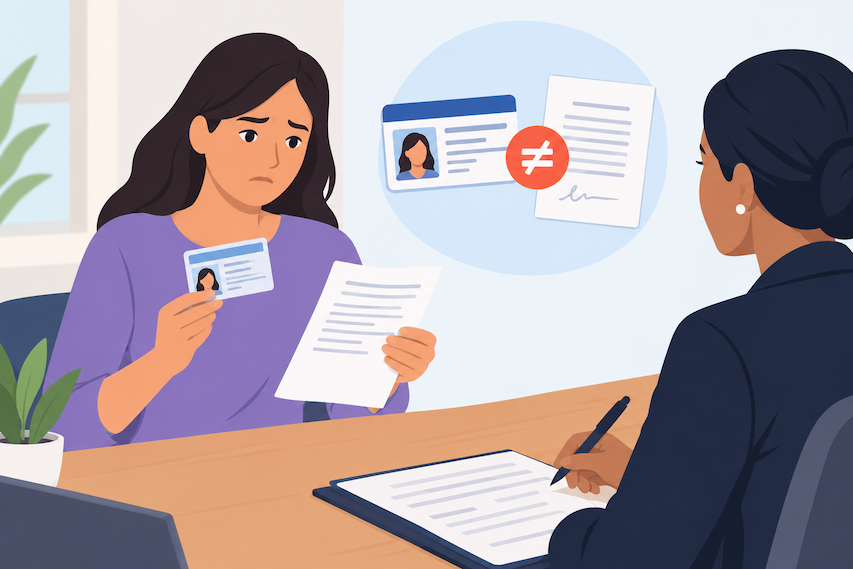
If the name on your identification does not match the name on your legal documents, your notary appointment may require additional review before the signing can proceed. A difference caused by marriage, divorce, a spelling error, or an outdated name does not automatically mean notarization is impossible, but you should address it before your appointment rather than assume the discrepancy will be accepted.
For important transactions such as mortgage closings, property transfers, powers of attorney, and affidavits, resolving a name mismatch early can help prevent avoidable delays, rejected paperwork, and rescheduled appointments.
What Is a Notary ID Name Mismatch?
A notary ID name mismatch occurs when the name shown on a signer’s identification differs from the name printed on the document being signed. The difference may be minor, such as a missing middle initial, or more significant, such as a former surname appearing on a driver’s license while the document uses a married name.
A notary must establish the signer’s identity according to the applicable legal requirements. When the names do not match, the notary may need clarification or additional guidance from the party responsible for preparing or receiving the document.
Common examples include:
A driver’s license shows a maiden name, but a mortgage document shows a married name.
A passport includes a middle name that is omitted from a legal document.
The identification contains a misspelled surname.
A legal document uses a former name after a divorce.
The name on a deed differs from the name on the signer’s current identification.
A loan document includes a suffix, such as Jr. or III, that does not appear on the identification.
The appropriate response depends on the nature of the difference, the applicable notary rules, and the requirements of the organization receiving the document.
Why Does the Name on Your ID Matter During Notarization?
The name matters because the notary needs to establish that the person appearing for the appointment is the individual identified in the document. A discrepancy can create uncertainty about identity, ownership, signing authority, or whether the document accurately identifies the intended person.
This is particularly important when the paperwork involves real estate, financial transactions, or legal authority over another person’s affairs.
Can a Notary Proceed If the Names Are Different?
A notary may be able to proceed in some circumstances, but a name discrepancy should not be treated as an automatic exception. The notary must comply with applicable identity-verification requirements and cannot simply assume that two different names belong to the same person.
For example, a signer might present a valid driver’s license under a former surname while a power of attorney identifies them by their current legal name. The signer may have a reasonable explanation, but the notary still needs to determine whether the identity requirements can be satisfied.
The document preparer, title company, lender, or attorney may also need to confirm whether the discrepancy is acceptable for the transaction.
Does Every Small Name Difference Cause a Problem?
Not necessarily. Some differences may be explainable, while others may require correction or additional documentation. A missing middle initial, for example, is not automatically equivalent to a completely different surname.
However, there is no universal rule that every minor variation can be ignored. The notary should evaluate the circumstances under the applicable law, and the organization receiving the document may impose additional requirements.
If you are unsure whether your identification will be sufficient, contact the notary and the responsible document preparer before the appointment.
What Are the Most Common Reasons for an ID Name Mismatch?
Name discrepancies often result from ordinary life changes or administrative errors. Identifying the cause early helps you ask the right questions and determine whether the document or supporting records need attention.
1. Marriage or Divorce
Marriage and divorce can lead to differences between the name on a person’s identification and the name recorded on older or newer legal documents.
For example, a property deed may use a previous surname while the signer’s current driver’s license reflects a new surname. A divorce-related transaction may also involve documents prepared under different names.
What to do: Explain the name change to the notary and contact the document preparer. Ask whether supporting records or a corrected document are necessary before signing.
2. Spelling Errors or Typographical Mistakes
A misspelled surname, transposed letters, or an incorrectly entered first name can cause a discrepancy between the identification and the document.
Even a small error may matter when the paperwork is part of a real estate closing or another transaction with strict documentation requirements.
What to do: Do not alter the document yourself. Notify the person or organization that prepared it and ask whether a corrected version is needed.
3. Missing Middle Names or Initials
Some identification documents display a full middle name, while other records use a middle initial or omit it entirely.
Whether this difference is acceptable depends on the document, the applicable requirements, and the receiving organization’s policies. Do not assume that a missing middle name will always be disregarded.
What to do: Send the exact name shown on your identification to the document preparer and ask whether the existing paperwork is acceptable.
4. Former Names on Older Documents
Older deeds, estate planning records, affidavits, and financial documents may identify a person by a name they no longer use.
The historical document may still be valid, but a new document must correctly identify the relevant person and reflect the transaction’s requirements.
What to do: Explain the history of the name difference and ask the responsible professional whether the current document needs revision or additional supporting records.
5. Differences in Suffixes or Name Formatting
A document may include a suffix such as Jr. or III, while the identification does not. Differences in hyphenation, spacing, or name order can also create questions.
These variations should be reviewed rather than automatically accepted or rejected.
What to do: Share the exact wording from both documents with the notary or document preparer before the appointment.
What Should You Do If Your ID Name Doesn’t Match Your Legal Documents?
The best approach is to address the discrepancy before the signing date. A short conversation with the notary and the organization preparing the paperwork can help determine whether you need corrected documents, supporting records, or another lawful solution.
Follow these steps.
Step 1: Compare the Names Carefully
Review your identification and the document you are expected to sign. Check the spelling of your first, middle, and last names, as well as any suffixes, hyphens, and former surnames.
Write down the exact differences so you can explain the issue clearly.
Step 2: Contact the Notary Before the Appointment
Tell the notary that the names do not match and explain why. Provide the document type and describe the discrepancy without assuming that it will be accepted.
If you are preparing for an appointment through a mobile notary service, raising the issue beforehand can help identify potential problems before the notary travels to your location.
Step 3: Notify the Document Preparer or Receiving Organization
For mortgage closings, contact the title company, lender, escrow officer, or closing attorney. For estate planning documents, contact the attorney or other professional responsible for preparing the paperwork.
Ask whether the document needs to be corrected, whether additional evidence is required, and whether the discrepancy could affect the transaction.
The notary may be able to explain notarization requirements, but the notary generally should not decide how a legal document must be drafted or interpret its legal effect for you.
Step 4: Gather Relevant Supporting Records
Depending on the situation, the responsible professional may ask you to provide records that explain the difference between the names.
Possible examples include:
A marriage certificate documenting a surname change.
A divorce decree or court order reflecting a name change.
An official court order establishing a legal name change.
Other records specifically requested by the document preparer or receiving organization.
These records do not automatically guarantee that a notary can proceed. Their usefulness depends on the circumstances and the requirements that apply to the transaction.
Step 5: Confirm the Next Step Before Signing
Before the appointment, ask whether the existing document can be used or whether a revised version is necessary.
If the discrepancy cannot be resolved in time, the appointment may need to be postponed. Although rescheduling can be inconvenient, it is generally better to address the issue before signing than to discover afterward that the paperwork cannot be accepted.
Can a Name Mismatch Delay a Mortgage Closing?
Yes. A name mismatch can delay a mortgage closing if the lender, title company, or other responsible party cannot verify the signer’s identity or requires corrected paperwork before proceeding.
Real estate transactions often involve multiple documents that must be completed consistently. A discrepancy discovered at the signing table may require additional review, revised documents, or a new appointment.
Potential consequences include:
Rescheduling: The signing may need to wait until the discrepancy is resolved.
Document corrections: The lender, title company, or attorney may need to prepare revised paperwork.
Additional review: The receiving organization may need to verify the signer’s identity or confirm the appropriate documentation.
Processing delays: Incomplete or unacceptable documents may affect the closing or funding timeline.
Not every discrepancy will delay a transaction. The impact depends on the type of document, the nature of the mismatch, and the requirements of the parties involved.
If you are preparing for a purchase, refinance, home equity line of credit, or seller signing, review the name on your identification as soon as you receive your closing instructions. A professional loan signing appointment can help keep the signing process organized, but the name discrepancy should still be addressed with the appropriate parties beforehand.
What Happens If the Notary Cannot Resolve the Name Discrepancy?
If the notary cannot establish the signer’s identity or otherwise satisfy the applicable requirements, the notarization generally cannot proceed. The notary should not ignore a discrepancy simply because the appointment is urgent or the signer provides a plausible explanation.
The next step depends on why the names differ and what the responsible organization requires.
Situation | Possible Next Step |
|---|---|
The document contains a typographical error | Contact the document preparer about correcting it. |
The ID uses a former surname | Ask whether supporting name-change records or revised paperwork are required. |
A middle name or suffix differs | Request confirmation from the notary and receiving organization. |
The discrepancy affects a mortgage closing | Contact the lender or title company immediately. |
Identity cannot be established satisfactorily | Resolve the identity issue before attempting notarization again. |
A notary cannot guarantee that a document will be accepted by a lender, court, government agency, or other recipient. The receiving organization may have requirements beyond those governing the notarization itself.
How Can You Prevent an ID Name Mismatch Before a Notary Appointment?
The easiest way to prevent avoidable delays is to compare your identification with the signing documents before the appointment. Early preparation gives the notary and document preparer time to identify issues and explain what needs to happen next.
Use this checklist:
Review the name printed on every relevant document.
Compare the name with your original identification.
Check for spelling errors, missing names, suffixes, and former surnames.
Tell the notary about any discrepancy before the appointment.
Contact the lender, title company, attorney, or document preparer when necessary.
Gather supporting records if requested.
Confirm whether the existing documents can be used or must be corrected.
Follow any additional identification instructions provided for your transaction.
For a broader explanation of acceptable identification, including the rules that apply to different ID types, read What ID Can a Florida Notary Accept? A Clear Guide. That article covers identification requirements, while this guide focuses on resolving differences between the names shown on identification and legal documents.
Frequently Asked Questions About Notary ID Name Mismatches
Can I Get a Document Notarized If My Last Name Is Different?
Possibly, but it depends on the circumstances and the applicable identification requirements. If your ID uses a maiden name, former surname, or another variation, contact the notary and the document preparer before the appointment to determine what documentation or correction may be needed.
Can a Notary Accept a Marriage Certificate as Proof of My Name Change?
A marriage certificate may help explain a surname difference, but it does not automatically satisfy every identification or transaction requirement. Ask the notary and the organization receiving the document whether the certificate is relevant and whether other steps are necessary.
What If My Name Is Misspelled on the Document?
Contact the document preparer before signing. The preparer or receiving organization should determine whether the document needs correction. Do not change legal or closing documents yourself unless the responsible professional has provided appropriate instructions.
Can I Use a Different ID That Has the Correct Name?
Another identification document may help, provided it qualifies under the applicable rules and is acceptable for the transaction. However, presenting a second ID does not automatically resolve a discrepancy in the legal document itself. Confirm the requirements with the notary and document preparer.
Will a Name Mismatch Automatically Cancel My Mortgage Closing?
No. A discrepancy does not automatically cancel a closing, but it can cause delays if it prevents the parties from completing or accepting the required paperwork. Contact your lender or title company promptly to find out what corrective action is necessary.
Should I Sign the Document First and Explain the Difference Later?
No. You should disclose the discrepancy before signing and follow the instructions of the notary and responsible document preparer. Signing first does not guarantee that the document will be accepted, and it may complicate the process if corrections are required.
Does Remote Online Notarization Solve a Name Mismatch?
Not necessarily. Remote online notarization has its own identity-verification requirements, and switching to an online appointment does not automatically resolve inconsistent names. If you are considering this option, ask whether your transaction is eligible and what documentation is required. You can learn more about the process through Signing With Lissy’s remote online notarization services.
Final Thoughts
A notary ID name mismatch does not always prevent a document from being notarized, but it should never be ignored. Differences caused by marriage, divorce, spelling errors, or outdated records should be reviewed before the appointment so the notary and the responsible organization can determine the appropriate next steps.
If you have an upcoming loan signing, property transaction, or legal document appointment in South Florida, prepare your identification early and communicate any discrepancies as soon as possible. Signing With Lissy provides professional loan signing and mobile notary services, with appointment preparation and clear communication designed to help identify potential issues before they cause unnecessary delays.
Disclaimer: This article provides general educational information and is not legal advice. Notarization and identity-verification requirements depend on applicable law, the type of document, and the policies of the organization receiving it. Consult the relevant attorney, lender, title company, or other qualified professional about your specific situation.
