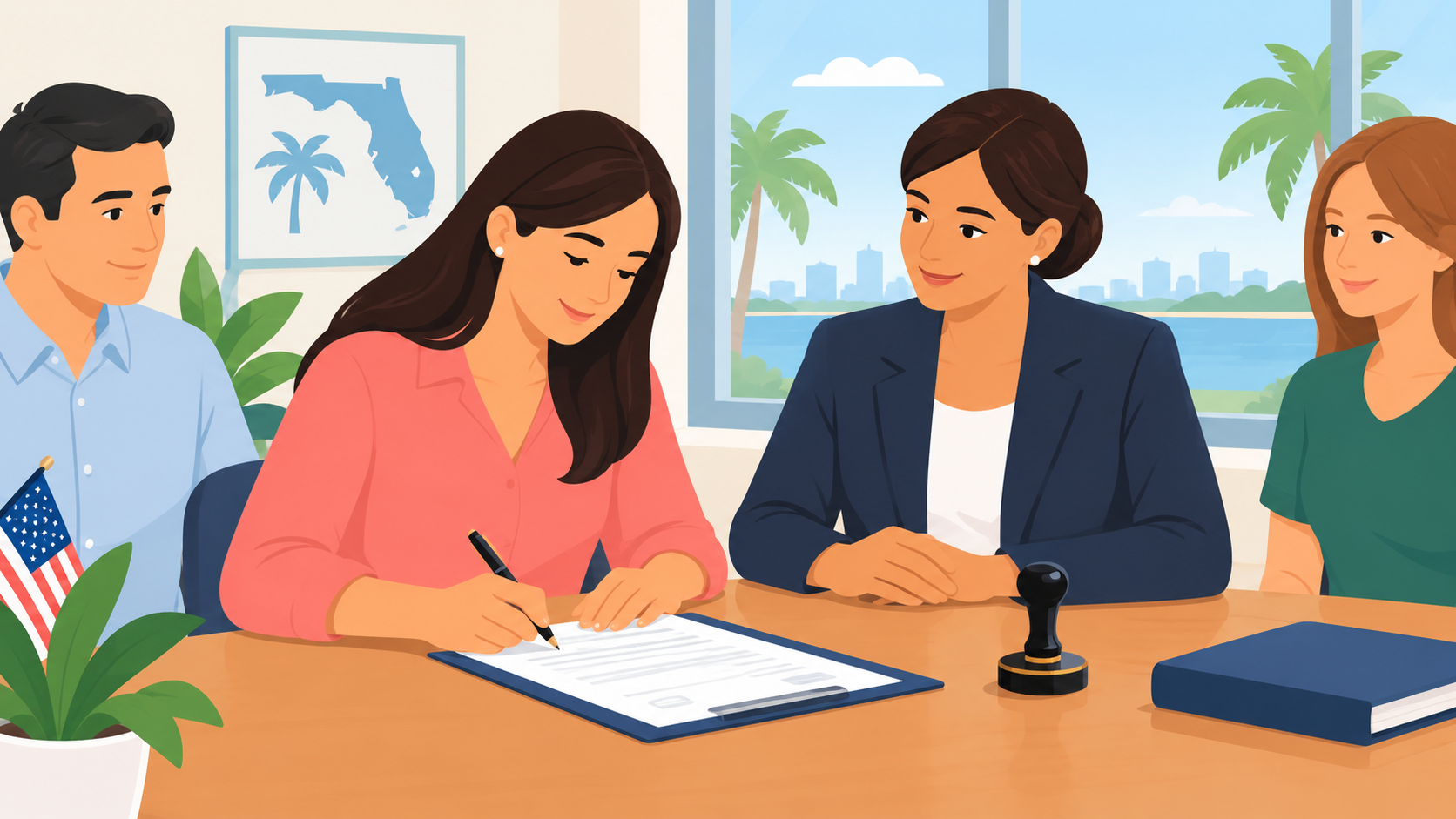
If you need to notarize a power of attorney in Florida, the document generally must be signed by the principal, witnessed by two subscribing witnesses, and acknowledged by the principal before a notary public. Florida law also has specific requirements for identification and notarization, so preparing the document and the people involved ahead of time can help prevent delays.
A power of attorney gives another person, known as an agent, authority to act on behalf of the person creating it, known as the principal. Because a power of attorney can give an agent significant legal authority, proper execution matters.
Whether you are preparing a power of attorney for financial matters, property, business, or another purpose, understanding the Florida notarization process can make the signing appointment much easier.
Important: A notary public verifies the identity of the signer and performs the required notarial act. A notary is not a substitute for an attorney and generally does not decide what powers should be included in your power of attorney. If you need help drafting or determining the legal effect of a power of attorney, speak with a qualified Florida attorney.
What Are the Florida Requirements for Notarizing a Power of Attorney?
A Florida power of attorney must be signed by the principal, signed by two subscribing witnesses, and acknowledged by the principal before a notary public. These execution requirements are established under Florida Statutes section 709.2105.
Before scheduling a notarization appointment, make sure you understand who needs to be present and what needs to happen during the signing.
For a typical Florida power of attorney, you will need:
The completed power of attorney document
The principal, who is granting the authority
Two subscribing witnesses
A Florida notary public
Acceptable identification for the principal
Any additional documents or instructions required by the attorney, financial institution, title company, or other organization involved
The exact circumstances can vary depending on the document and transaction. If the power of attorney involves significant assets, real estate, estate planning, or another complicated legal matter, having the document prepared or reviewed by an attorney can be especially important.
Who Is the Principal and Who Is the Agent?
The principal is the person giving someone else authority to act on their behalf. The agent is the person receiving that authority.
For example, a Florida resident may create a power of attorney that authorizes an adult child to handle certain financial matters. The parent is the principal, while the child is the agent.
Florida law requires an agent to be a natural person who is at least 18 years old, or certain qualifying financial institutions.
The agent’s authority comes from the language of the power of attorney. An agent generally may exercise authority specifically granted in the document, which is why the wording of the document matters.
If you are unsure which powers an agent should receive, that is a legal question rather than a notarial one.
Does a Power of Attorney Need Two Witnesses in Florida?
Yes. For a Florida power of attorney executed under the current Florida Power of Attorney Act, the principal must sign the document with two subscribing witnesses, and the principal must acknowledge the document before a notary public.
The witnesses are part of the execution process, so it is important to plan for them before the appointment.
A simple way to prepare is to confirm all participants in advance:
The principal knows what document is being signed.
The two witnesses are available at the same appointment.
The notary is available to perform the acknowledgment.
The principal has acceptable identification.
The document is ready for execution.
If you are arranging a mobile appointment, confirming these details beforehand can make the signing much smoother.
For additional preparation tips, you can review this practical checklist for preparing for a mobile notary appointment.
What Identification Does a Florida Notary Require?
A Florida notary must have personal knowledge of the signer or satisfactory evidence that the signer is the person identified in the document. Florida law lists acceptable forms of identification and requires the notary to record the identification information used for the notarization.
Common identification options can include:
A Florida driver’s license or identification card
A U.S. passport
Certain driver’s licenses or identification cards issued by another state or qualifying jurisdiction
Other forms of identification that meet Florida’s statutory requirements
Under Florida law, qualifying identification generally must be current or have been issued within the previous five years and contain a serial or other identifying number.
Before the appointment, ask the notary what identification they will accept. This is especially helpful if the principal has an expired ID, recently changed their name, or has difficulty obtaining standard identification.
How Do You Notarize a Power of Attorney in Florida?
The process is straightforward when the document, principal, witnesses, and identification are ready.
1. Prepare the Power of Attorney Document
The first step is obtaining the correct power of attorney.
The document should clearly identify the principal and agent and describe the authority being granted. Because the wording can determine what the agent is legally permitted to do, the document should be prepared or reviewed by an appropriate legal professional when necessary.
A notary generally does not draft a power of attorney or determine which powers you should give an agent.
If your power of attorney is part of a larger estate-planning package, Signing With Lissy also provides notarization services for estate planning documents in South Florida.
2. Arrange Two Witnesses
Florida requires two subscribing witnesses for the execution of a power of attorney.
Arrange for both witnesses to be available when the principal signs. Do not assume that the notary will automatically provide witnesses unless you have specifically confirmed that service in advance.
It is also a good idea to tell the notary beforehand that the document is a power of attorney and that two witnesses will be involved.
3. Make Sure the Principal Is Present
The principal is the person whose signature is being notarized, so the principal must appear before the notary as required for the notarial act.
Florida law requires the notary to establish the signer’s identity through personal knowledge or satisfactory evidence.
The principal should also be able to communicate with the notary and voluntarily acknowledge the document.
If there are concerns about the principal’s ability to understand the signing, stop and seek appropriate legal advice before proceeding. A notary’s role is not to make a legal or medical determination about capacity.
4. Sign the Document With the Required Witnesses
The principal signs the power of attorney according to the document’s instructions, with the two subscribing witnesses participating as required.
Do not sign pages in advance unless the attorney or notary handling the document has specifically confirmed that doing so is appropriate.
Keeping the signing process together can reduce the chance of a missing signature, incomplete witness section, or improperly completed notarial certificate.
5. Complete the Notarization
After the principal signs and acknowledges the document, the notary completes the appropriate notarial certificate.
Florida law requires the notarial certificate to identify the location, type of notarial act, date, signer, identification method, and other required information, along with the notary’s signature and official seal.
The notary should complete the certificate according to the actual circumstances of the signing.
6. Review the Completed Document
Before everyone leaves, check the document carefully.
Look for:
Principal’s signature
Two witness signatures
Completed notarial certificate
Correct names
Correct dates
Notary signature
Notary seal
Any required initials or additional signatures
A final review can catch simple omissions before the document is submitted to a bank, attorney, title company, government office, or another organization.
Can a Florida Power of Attorney Be Notarized at Home?
Yes. A mobile notary can meet the principal at a suitable location, such as a home, office, hospital, or care facility, subject to the notary’s availability and the circumstances of the appointment.
This can be particularly helpful when the principal has limited mobility or would prefer not to travel.
Signing With Lissy provides mobile notary services at homes, offices, hospitals, and care facilities, making the process more convenient for clients throughout South Florida.
When scheduling a mobile appointment, provide the notary with the location, document type, number of signers, witness requirements, and any special circumstances in advance.
Can You Notarize a Power of Attorney Online in Florida?
Florida law allows online notarization under its remote online notarization provisions, but whether a particular power of attorney should be completed online depends on the document, the parties involved, and the requirements of the organization that will receive it.
Florida’s notarial laws recognize notarial acts performed through authorized audio-video communication technology, subject to the applicable requirements.
If you are considering remote online notarization, confirm beforehand that the document and transaction are appropriate for an online signing.
Signing With Lissy offers remote online notarization for eligible transactions, which may be convenient when the signer cannot meet a notary in person.
For documents involving real estate, financial institutions, estate planning, or other high-value transactions, it is also smart to confirm acceptance requirements with the organization receiving the power of attorney.
Does a Power of Attorney Have to Be Durable in Florida?
No. A power of attorney and a durable power of attorney are not automatically the same thing.
Under Florida law, a power of attorney is durable when it contains language showing the principal’s intent that the agent’s authority continues despite the principal’s subsequent incapacity.
This distinction can be especially important in estate planning.
A durable power of attorney can be designed to remain effective despite a later loss of capacity, subject to the terms of the document and Florida law.
Because the choice between different types of powers of attorney can have significant legal consequences, consult an attorney if you are unsure which form is appropriate.
You can also learn more about how notarization fits into estate planning and other important legal documents in South Florida.
When Does a Florida Power of Attorney Become Effective?
Under Florida law, a power of attorney is generally exercisable when executed, subject to statutory exceptions. New powers of attorney generally cannot simply be written to become effective only upon a future event or contingency.
This is an important difference from older assumptions about “springing” powers of attorney.
If you are creating a new document and want the agent’s authority to operate in a particular way, the language should be reviewed carefully by a qualified Florida attorney.
The notary’s job is to properly perform the notarial act; the notary does not decide when the agent’s authority should begin.
Can You Use a Power of Attorney From Another State in Florida?
Potentially, yes. Florida law provides that a power of attorney executed in another state can remain valid in Florida if it complied with the law of the state where it was executed at the time of execution.
That does not mean every out-of-state document will automatically be accepted for every transaction.
A bank, title company, government agency, or other organization may have its own review requirements. If an out-of-state power of attorney will be used for an important transaction in Florida, confirm its acceptability with the receiving organization or an attorney.
What Happens If the Power of Attorney Is Not Properly Notarized?
If the execution requirements are not satisfied, the power of attorney may not be valid under Florida law.
For powers of attorney executed on or after October 1, 2011, Florida law provides that validity depends on compliance with the applicable execution requirements.
A missing witness, incomplete notarial certificate, incorrect execution, or identification problem can create delays when the document is presented to a third party.
This is why it is worth checking the document before the appointment rather than discovering a problem after the signing is complete.
For more information about preparing documents for notarization, see this South Florida checklist of essential documents that commonly require notarization.
Can a Power of Attorney Be Revoked in Florida?
Yes. A principal can generally revoke a power of attorney by executing a subsequent power of attorney or another signed writing expressing the revocation.
Simply creating another power of attorney does not automatically revoke an earlier one unless the new document or other signed writing expresses the revocation as required by law.
Because revocation can affect financial, property, and other legal authority, it is best to discuss the situation with an attorney when significant assets or ongoing transactions are involved.
What Should You Bring to a Power of Attorney Notarization?
Being prepared can make the appointment faster and reduce the chance of having to reschedule.
Power of Attorney Notarization Checklist
Bring or arrange the following:
The complete power of attorney document
Make sure you have the correct final version.Valid identification for the principal
Bring an acceptable form of identification that meets Florida requirements.Two subscribing witnesses
Confirm both witnesses can attend the signing.Any attorney instructions
Follow any specific signing instructions provided by the attorney who prepared the document.Contact information for the receiving organization
If a bank, title company, or another organization will receive the document, know whether it has special requirements.A suitable signing location
For a mobile appointment, make sure there is enough space for the principal, witnesses, and notary to complete the paperwork comfortably.
If you need a notary to travel to you, understanding how mobile notary services work from scheduling through the appointment can help you prepare.
Common Mistakes to Avoid When Notarizing a Power of Attorney
Most problems are preventable when the signing is organized in advance.
Avoid these common mistakes:
Arriving without acceptable identification
Forgetting that two subscribing witnesses are required
Signing the document before the notary appointment without confirming the instructions
Using an outdated or incorrect version of the document
Leaving required signature or initial sections incomplete
Assuming the notary can explain or change the legal terms
Failing to confirm whether the receiving organization accepts the document
Waiting until the last minute to arrange witnesses
Assuming a new power of attorney automatically revokes an older one
If the document is complicated or gives an agent significant financial or property authority, legal advice should come before the notarization appointment.
Power of Attorney Notarization vs. Other Notary Services
A power of attorney is one of many documents that may require notarization. The process can look different depending on the document and its legal requirements.
Document or Service | Common Purpose | Notarization Consideration |
|---|---|---|
Power of attorney | Gives an agent authority to act for the principal | Florida execution requires two subscribing witnesses and acknowledgment before a notary |
Estate planning documents | Helps organize legal and financial wishes | Requirements vary by document |
Affidavit | Allows someone to make a sworn statement | Usually involves an oath or affirmation |
Loan documents | Supports a mortgage or other financing transaction | May involve numerous signatures and notarizations |
General legal documents | Supports various legal transactions | Requirements depend on the document |
If you are dealing with a document outside of a power of attorney, Signing With Lissy also provides legal document notarization services in South Florida.
Frequently Asked Questions About Florida Power of Attorney Notarization
Does a power of attorney need to be notarized in Florida?
Yes. Under Florida Statutes section 709.2105, a power of attorney must be signed by the principal and two subscribing witnesses and acknowledged by the principal before a notary public or as otherwise provided by law.
How many witnesses are required for a Florida power of attorney?
Two subscribing witnesses are required for the execution of a Florida power of attorney. The principal must also acknowledge the document before a notary public.
Does the agent need to be present when the power of attorney is notarized?
The Florida execution statute requires the principal’s signature, two subscribing witnesses, and the principal’s acknowledgment before a notary. It does not state in that execution provision that the agent must be present for the principal’s notarization.
However, the document or receiving organization may have additional requirements, so confirm those requirements before the appointment.
Can a mobile notary notarize a power of attorney at my home?
A mobile notary can travel to a client’s home or another agreed location to perform eligible notarial services. The principal, required witnesses, identification, and document should be ready for the appointment.
Can I notarize a power of attorney online in Florida?
Florida law permits authorized online notarizations, but whether a particular power of attorney can or should be completed remotely depends on the circumstances and any requirements of the organization receiving the document.
Can a Florida notary prepare my power of attorney?
A notary’s role is to perform the notarial act, not to decide what legal powers should be granted or draft legal documents for you. If you need help preparing the language, consult a qualified attorney.
Does a durable power of attorney continue after incapacity?
A Florida power of attorney is durable when its language shows the principal’s intent that the authority remains exercisable despite the principal’s subsequent incapacity.
Can I revoke a power of attorney?
Generally, yes. Florida law allows a principal to revoke a power of attorney through a subsequently executed power of attorney or another signed writing expressing the revocation.
Key Takeaways
A Florida power of attorney generally requires the principal’s signature, two subscribing witnesses, and acknowledgment before a notary.
The principal must be properly identified by the notary through personal knowledge or satisfactory evidence.
The agent does not necessarily need to attend the notarization under the basic execution requirements, although other parties may have additional requirements.
A notary verifies identity and performs the notarial act but does not replace an attorney when legal advice or document drafting is needed.
Mobile notarization can be convenient for people who prefer to sign at home, work, a hospital, or another suitable location.
Florida also permits authorized online notarization, although the document and transaction should be confirmed as eligible before using a remote option.
A durable power of attorney is designed to remain effective despite the principal’s later incapacity when the document contains the required intent and language.
If the document involves significant financial, real estate, or estate-planning decisions, legal review can help prevent costly problems later.
Final Thoughts
Notarizing a power of attorney in Florida involves more than simply putting a notary seal on a signature. The principal, two subscribing witnesses, identification, document, and notarial acknowledgment all need to be handled correctly.
Preparing everything before the appointment can make the process much easier. If the principal has mobility limitations or prefers to sign at home, a mobile notary can bring the service to a convenient location.
For complicated powers of attorney, especially those involving estate planning, real estate, or substantial financial authority, consider having the document prepared or reviewed by a qualified Florida attorney before scheduling the notarization.
Signing With Lissy provides professional mobile notary, remote online notarization, and legal and estate-planning document services throughout South Florida.
